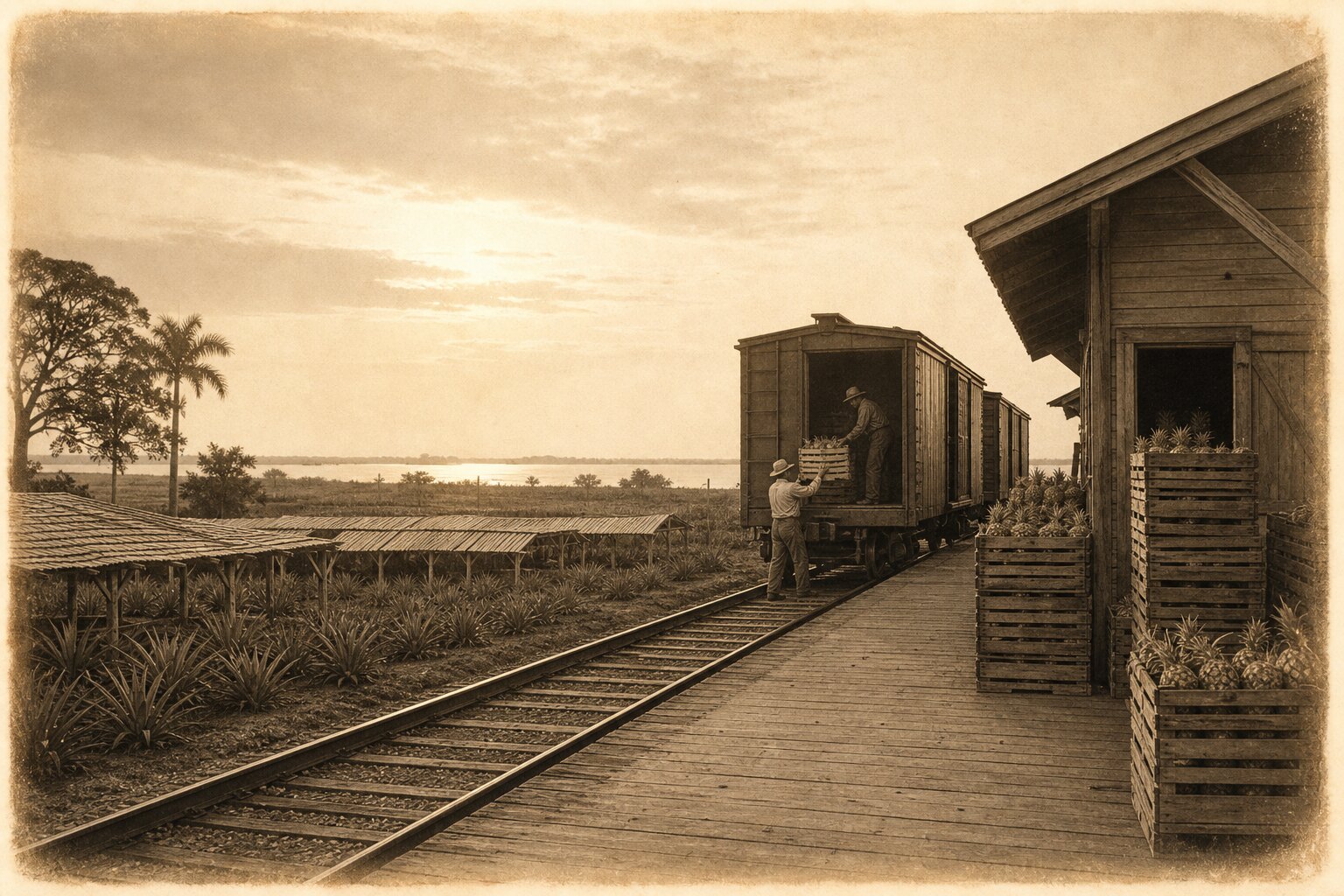
In the autumn of 1909 Fort Pierce had two thousand inhabitants and seventeen stores. It was the county seat, the commercial center of the middle East Coast, and the division headquarters of the Florida East Coast Railway. It stood in the heart of the pineapple belt, in what its own newspaper called, under its name every week, the banner pineapple county of the State, and it was headquarters for the fruit and produce buyers during the seasons. Those last two facts are what this page is about.
The county-wide story of the crop, the record season of 1909, the fight with Cuban fruit over freight and tariff, and the county’s claim to more than half the state’s pineapples, is told by our sister publication in Pineapple Plantations of the Indian River. This is the town’s end of it: the belt as a visitor saw it walking south from the depot, the trade the crop supported on the town’s streets, the growers who lived along the river road, and the meetings they held in the Improvement Club hall.
A walk south from the depot, June 1906
The belt ran twenty-eight miles along the Indian and St. Lucie rivers, from Viking north of Fort Pierce to Stuart, one to three miles wide, about twenty-five miles of it in St. Lucie County, with the railway running through the whole length. Start from the Fort Pierce depot some bright June morning in 1906, with the crop moving, and walk south along the track. Within a few minutes there are fields of the fruit on both sides of you and packing houses at regular intervals. Each field has twelve to fifteen hands picking and carrying; each packing house has nearly as many making crates, wrapping, packing and stenciling, with one to three teams hauling the fruit.
You pass the stations of White City, Eldred, Ankona, Tibbals and Jensen, cross the St. Lucie River to Stuart, then in Dade County, and meet the same scene the whole way, varied only by the size of the plantation. You meet dozens of transportation agents, commission solicitors and pineapple buyers, and you keep a sharp lookout for the special pineapple pickup trains the railroad put on for the harvest.
The arithmetic went with the walk. The sidings were about a mile apart, so growers whose packing houses did not sit on one hauled their crates by wagon, and hard-surfaced roads were wanted for the purpose. In the season about 15,000 crates went out from each mile of track, and at the railroad’s share of about twenty-five cents a crate that came to nearly $4,000 of freight to the mile. Coming the other way were some three hundred cars of fertilizer, about nine million pounds, and a car of wrapping paper by itself.
Two weeks earlier the fruit had begun leaving the East Coast in train-load lots, a hundred thousand crates from this section in two or three weeks. And on a Sunday afternoon that June the river road south of town was the drive to take. You did not have to go far: the pineapple fields began at the town limits, and the planters’ houses faced the river along the road, with lawns and flower gardens.
One grower was asleep in a hammock on the veranda, another was entertaining visitors, a third had found a cool spot with a book, music came from the next house, and a couple of hundred yards on there was a tea party on the lawn. During the rush you would hardly find anyone with time to talk to you unless you wanted to buy a few carloads of pineapples.
What the town sold the growers
A crop that size fed the town’s trade. The East Coast Lumber and Supply Company, with yards at Fort Pierce, Eau Gallie, Titusville and West Palm Beach, sold pineapple crates, wraps and nails through the winter of 1905 and 1906, and for the season of 1907 it offered two hundred thousand crates at thirteen cents each, delivered by the carload to any station between Eau Gallie and Stuart.
Consider what a season’s crates meant. In 1906 about six hundred thousand crates had gone out of the section; 1907 fell short of that and 1908 would too, but five hundred thousand was a fair estimate for the year. Five hundred thousand crates at three hundred to the car made 1,667 cars, a train twelve miles long, from Fort Pierce to Eden. Laid end to end the crates would reach from Jacksonville to West Palm Beach. Each one held eleven pieces of lumber, twenty-seven feet of it, and the crate material alone came in on eighty cars.
Fee and Stewart, the hardware house, spoke to the same customers. Its advertisement to pineapple men in August 1908 said the wheelbarrow selling season was over and now they had the hoe, just the thing for digging up old pineapple fields.
Even the churches took a hand. The Baptist Workers, the women’s society of the Baptist church, met at the home of Mrs. H. W. Lennard in the spring of 1906 to make pineapple gloves, which they sold for the benefit of the society. By April they had a large order to fill and called an all-day meeting to finish it, they were still making gloves in June with the crop moving, and the next spring the society had pineapple gloves and leggings for sale.
The growers advertised alongside the merchants. In the late summer of 1905 H. E. Hill of Fort Pierce offered Abbaka slips and suckers cheap, and M. E. Card on the River road offered Red Spanish slips from a young field. Through the summer of 1906 James E. Andrews of Fort Pierce advertised two hundred thousand Red Spanish slips, very fine, from young plants. Andrews was also the county judge, a real-estate man, and the manager of the Fort Pierce Land and Improvement Company, which says something about who grew pineapples at the county seat.
The meetings in the club hall
When the pineapple growers of the coast needed to meet, they met in Fort Pierce, in the Improvement Club hall. On Tuesday, November 20, 1906, the growers who had tried the English market that season came to hear how it had gone, about twenty-five of them from Fort Pierce to Dania, from both St. Lucie and Dade counties, and James E. Andrews of Fort Pierce was chosen to preside.
The man they came to hear was James E. Ingraham, third vice-president of the Florida East Coast Railway, a grower and exporter himself, and as near to a godfather as the pineapple export business had. He had spent three months in the British Isles in the summer of 1905 studying the fruit markets, and had found a great demand for pineapples if they could be landed in good condition at a price ordinary people could pay; the only competition was fruit from the Azores, priced for the rich.
The plan was to get Florida pineapples into England ahead of the English strawberry crop, before June 20. Early in 1906 he had gathered the larger growers at Miami and taken pledges for five thousand crates. In the end 5,929 crates went.
Everything that left Florida before the first of June netted the growers about four dollars a crate. Then the market fell, the last shipments landed on top of the strawberries, and by the first of July the bottom had been reached; a few late shipments netted less than a dollar. Ingraham’s own first carload of 303 crates had netted $4.08 a crate, over twelve hundred dollars, and a West Palm Beach grower had done as well on his first forty-two. After dinner the meeting reconvened at two o’clock, and Walter Hawkins of the Consolidated Fruit Company, which had forwarded every export shipment, laid out the manifests, cablegrams, freight bills and account sales for each one.
The Indian River Pineapple Growers’ League met in the same building. On Wednesday, February 6, 1907, about twenty-five growers heard the report of two delegates who had gone to Jacksonville, where the Florida Fruit and Vegetable Shippers’ Protective Association had just been formed to fight freight rates. Florida shippers paid seventy-five cents a crate for the thousand-mile haul to New York, their cheapest market, while California fruit went three times as far. Most of the men present enrolled in the state organization on the spot.
The same afternoon a petition went round for the opening of the inlet at Sewalls Point, each grower pledging two cents on every crate he shipped that season; the argument was that once vessels could enter the Indian River, freight rates would fall by a fifth. Seventeen growers representing 72,000 crates had signed within two days, and a man who grew no pineapples had put up fifty dollars.
Five weeks later, on March 13, the League’s vice-president, C. A. Robinson, stood up at its semi-annual meeting in Fort Pierce and told the members what the League was for, because the railroad’s officials had been told it was a body raised to fight them. It was nothing of the kind, he said.
It had been born in the winter of 1903, when the railway gave out that it would discontinue the pickup train and expect growers to load anything over twenty-five crates into cars at the nearest siding themselves; the commotion led to a mass meeting, and the growers organized so they could put their wants before the company as one body. Its purpose was to adjust questions with the transportation companies amicably, and it had never yet had to go to the Railroad Commission. He also admitted that the League had virtually been asleep for a year or two, and was now, like Rip Van Winkle, waking up.
Fort Pierce pineapple growers organize: the Ridge, 1909
The town’s own growers organized in 1909. On Wednesday afternoon, February 3, at the residence of A. N. Hoofnagle south of town, the Ridge Pineapple Growers’ Association was formed, with Hoofnagle president and R. L. Goodwin secretary, and a committee of Hoofnagle, C. F. Olmstead and Charles Chase to draw up a constitution and by-laws. Its purpose was to cooperate for the betterment of the local conditions surrounding the packing, shipping and marketing of the crop.
The new body decided to affiliate with the older Indian River and Lake Worth Pineapple Growers’ Association and to join its work for a higher tariff on imported fruit, and a salesman for a Pittsburgh commission house was introduced to the room. By June it was an infant organization for mutual protection in marketing fruit, about a score of progressive growers within three miles south of Fort Pierce, in its experimental first year.
Hoofnagle had put himself up for county commissioner from the third district the year before and was serving by 1909, and he was among the largest pineapple growers around. Goodwin was one of St. Lucie County’s directors of the new East Coast Fruit and Vegetable Growers’ Association, and he was the live wire behind the largest pineapple meeting the town had seen.
On Monday afternoon, August 2, 1909, a hundred and ten people, seven of them women, filled the Improvement Club hall for a mass meeting of the county’s pineapple growers, from Sebastian, Quay, Vero, Oslo, Viking, St. Lucie, Fort Pierce, White City, Eldred, Ankona, Walton, Eden, Jensen and Rio. It was the most enthusiastic gathering of pineapple men the section had held, and every man in the room understood that conditions among the producers demanded concentrated action.
That summer a Fort Pierce pineapple made the news on its own. On the last day of May 1909 Charles Lord, one of the Ridge growers, sent the Fort Pierce News one that measured twenty inches around, stood eight inches high without its crown, and weighed six and a half pounds, grown on a plantation near town. The county had long been called the banner pineapple section of the world, and that had been talk; carload after carload going out from the farms was business.
Dances in the packing houses
The packing houses had another use in the winter, when there was no fruit in them. On Saturday evening, January 12, 1907, the friends of Mrs. Charles Lord gave her a surprise party in the packing house on the Lords’ place south of town, and about sixty people came from town and along the river front. The invitations, written on pieces of muslin, styled it an old-fashioned rag party, and everyone vied to turn out in the oldest garments they could resurrect; there was dancing and music, refreshments, and a pot of coffee boiled at the packing house.
Charles Chase, who would sit on the Ridge association’s by-laws committee two years later, took one of the prizes. Seven weeks on, a large party of ridge folks with a few from Fort Pierce and White City went to a barn dance at A. N. Hoofnagle’s packing house, and at the approach of midnight they were served a supper before they set off for home.
Showing the county’s pines
The town also showed the crop off. When Florida held its state fair at Tampa in February 1908, the county’s commissioner to it was Arthur B. Brown, editor and proprietor of the Fort Pierce News, and with one week to collect and prepare an exhibit he put up a display second to none in the things he made a feature of: a thousand Red Spanish pineapples grown in the open air without sheds, and Red Spanish plants in tubs showing the fruit from bud and bloom to the matured apple.
The next winter the county commissioners and the Board of Trade of Fort Pierce sent an exhibit to the exposition at Jacksonville, and James E. Andrews went up to place it.
The booth held a miniature pineapple field set out in the ground, with plants in every stage from the first blush of bloom to the ripened fruit and the white sand and slips of a young field at one end; the county’s varieties, Red Spanish first, then Abbaka, Smooth Cayenne, Porto Rico, Egyptian Queen and Sugar Loaf, and one wild pine; a five-foot panoramic photograph of Fort Pierce; and photographs of a pineapple field from the clearing to a view of two hundred acres ready to pick, a picking scene, a packing-house scene, and a platform stacked for shipment, all taken by the Florida Photographic Concern of Fort Pierce, which had been Mr. Flagler’s official photographer on the East Coast.
The seasons went on like that to the end of the decade. On Tuesday, June 6, 1911, M. E. Card, the same grower who had offered his Red Spanish slips on the River road six years before and by now a prominent planter of the Ridge south of town, shipped one of the first carloads of the year from this section: three hundred crates, 296 of them packed twenty-four to the crate and the other four eighteen, a car that ran exceptionally well for size and quality and as good as any that had gone out of Fort Pierce in three years.
The county-wide story, the record crop of 1909 and the fight over freight and tariff that was already on in that record year, is on the Record’s page, Pineapple Plantations of the Indian River; what became of the pineapple after 1911 is a later chapter. The crop that took its place is the subject of Indian River citrus and the Fort Pierce groves, and the fish houses on the same waterfront are in the fishing industry of Fort Pierce. For the town’s whole story, see the Fort Pierce timeline and the rest of our industries.
Sources
This story is drawn from the two Fort Pierce weeklies of the day, The St. Lucie County Tribune and the Fort Pierce News, digitized by the Library of Congress in Chronicling America and in the public domain.
The walk south from the depot is in the Tribune of June 22, 1906, and the Sunday drive in the issue of June 29; the export meeting in both papers of November 23, 1906; the League meetings in the Tribune of February 8 and March 15, 1907, and the packing-house parties in its issues of January 18 and March 8, 1907.
The crate arithmetic is in the News of June 26, 1908; the Ridge association in the News of February 5 and June 4, 1909, and the mass meeting in the issue of August 6, 1909; the fairs in the News of February 14, 1908 and March 12, 1909; the town’s description of itself in the News of November 5, 1909; and the 1911 carload in the News of June 9, 1911.