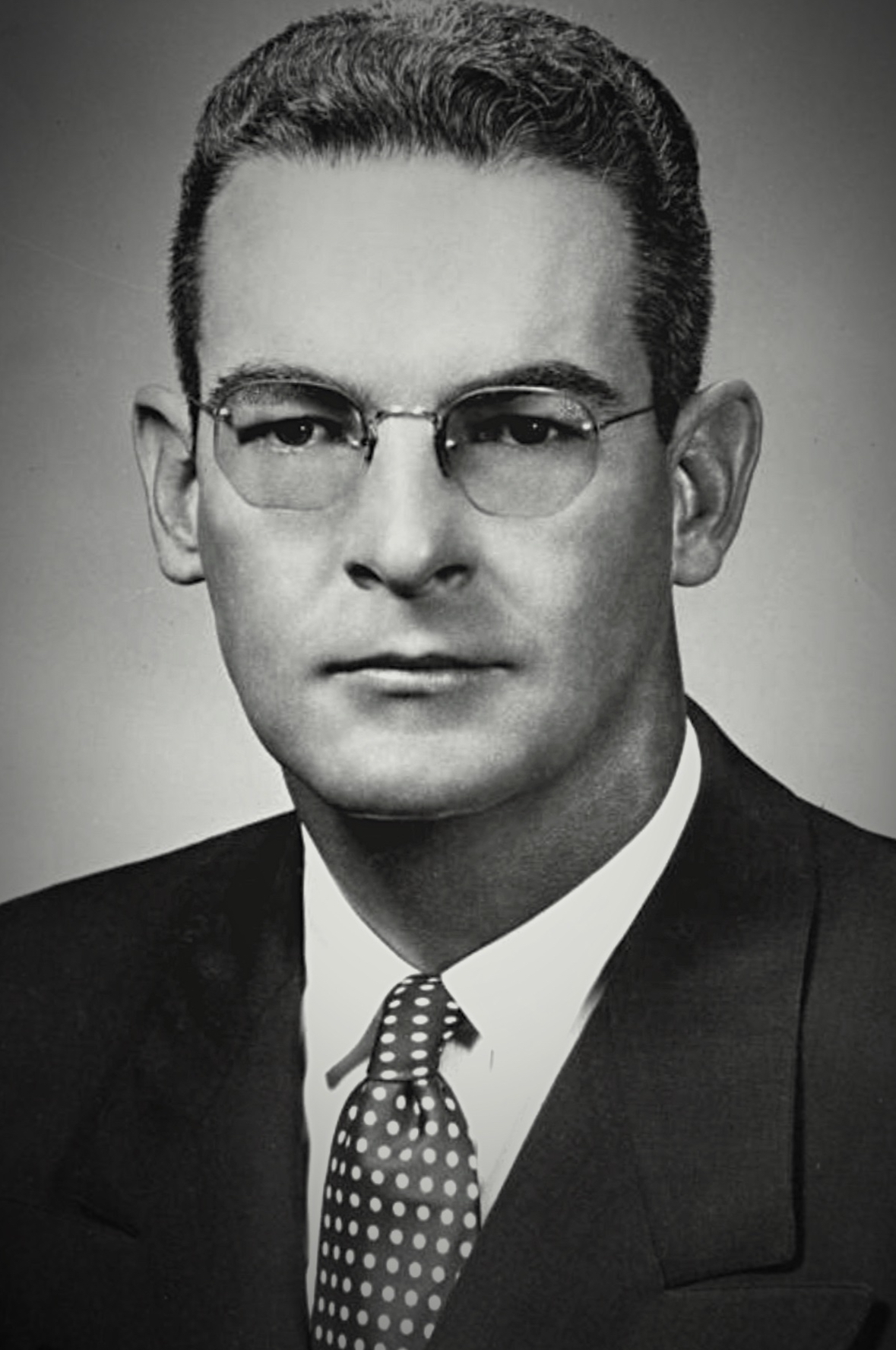
Daniel Thomas McCarty was born on January 18, 1912, in Fort Pierce, Florida, a small city on the Indian River Lagoon that was then at the center of the state's booming citrus industry. He would grow up to become the 31st Governor of Florida, a decorated World War II combat veteran, and a rising figure in Florida politics. His death in office at the age of forty-one, less than nine months after his inauguration, cut that career short. McCarty's story is inseparable from the story of Fort Pierce itself, from the citrus groves that shaped his family's fortunes to the civic culture that launched his career in public service.
A Fort Pierce family
The McCarty family was among the most prominent in St. Lucie County during the early twentieth century. Dan McCarty's father, Daniel Thomas McCarty Sr., was a successful citrus grower and packer whose operations were part of the vast agricultural economy that defined the Treasure Coast during the first half of the century.
The Indian River citrus district, stretching along the east coast of Florida from roughly Daytona Beach south through Fort Pierce and beyond, produced oranges and grapefruit that were prized for their sweetness and quality. Fort Pierce, situated at the southern end of this district, was a hub of citrus packing, shipping, and commerce. The citrus industry employed thousands and generated the wealth that built the city's early infrastructure: its roads, schools, churches, and public buildings.
Young Dan McCarty grew up in this world of groves and packing houses, Indian River breezes and the rhythms of the agricultural calendar. He attended Fort Pierce public schools, where he was known as a bright, ambitious, and popular student. He graduated from Fort Pierce High School, an institution that served as a gathering point for the sons and daughters of the city's citrus elite as well as its working-class families.
Fort Pierce in the 1920s was a community shaped by the Florida land boom and the optimism it generated, though the bust of 1926 and the devastating 1928 Okeechobee Hurricane tempered that optimism with hard experience. The McCarty family weathered these storms (literal and economic) and Dan McCarty carried with him throughout his life the values of the community that raised him: hard work, civic obligation, and a deep attachment to the land.
After high school, McCarty enrolled at the University of Florida in Gainesville, where he studied agriculture and immersed himself in campus life. He was a member of the Alpha Tau Omega fraternity and was active in student government and other organizations. He graduated in 1934, at the height of the Great Depression, and returned to Fort Pierce to work in the family citrus business. His entry into the groves and packing houses of St. Lucie County was a natural step for a young man of his background, but McCarty's ambitions extended beyond agriculture. He was drawn to public life, and it was not long before he entered politics.
The Indian River citrus district
The Indian River citrus district refers to the region along Florida's eastern coast where citrus fruit (primarily oranges and grapefruit) has been commercially grown since the nineteenth century. Named for the Indian River Lagoon, the district's combination of sandy soil, coastal warmth, and maritime humidity produces fruit noted for its exceptional sweetness and juice content. Fort Pierce, located in St. Lucie County, has been a major center of Indian River citrus production and packing since the early 1900s. For more on the role of citrus in the region's development, visit Saint Lucie History.
Political rise in the Florida Legislature
In 1937, at the age of twenty-five, Dan McCarty was elected to the Florida House of Representatives, representing St. Lucie County. He was one of the youngest members of the legislature, but he quickly distinguished himself as an effective and serious-minded lawmaker. During his four years in the House, from 1937 to 1941, McCarty focused on issues of importance to his constituents: agriculture, infrastructure, and economic development. He was a skilled negotiator and coalition builder, earning respect from colleagues on both sides of the political aisle. His legislative career gave him a deep understanding of state government and the network of relationships that would later propel his bid for the governorship.
McCarty's tenure in the legislature coincided with a period of significant change in Florida. The state was emerging from the worst of the Depression, aided by New Deal programs that built roads, bridges, schools, and other public works throughout the state.
Florida's population was growing, driven by the same climate and cheap land that had fueled the boom of the 1920s, and the state was beginning to transition from a predominantly rural, agricultural economy toward the more diversified economy of the postwar era. McCarty, as a young legislator from one of the state's most productive agricultural counties, had a front-row seat to this transformation. His experience in the House gave him both the policy knowledge and the political connections that would define the next phase of his career.
World War II service
The Japanese attack on Pearl Harbor on December 7, 1941, transformed the lives of millions of Americans, and Dan McCarty was no exception. He entered the United States Army and was commissioned as an officer, serving with distinction throughout the war. His military record was exemplary. McCarty participated in the Allied invasion of Normandy on June 6, 1944, D-Day, the largest amphibious military operation in history.
The landings on the beaches of northern France, which opened the Western Front against Nazi Germany, were among the most harrowing and consequential military operations of the twentieth century. McCarty's courage and leadership during the invasion and the subsequent campaign across France and into Germany earned him the Bronze Star, one of the United States military's highest awards for meritorious achievement in combat.
Fort Pierce itself played an important role in the American war effort. The city was home to a major amphibious training base where the Navy's Underwater Demolition Teams (the forerunners of the modern Navy SEALs) trained for beach assault operations in the Pacific and European theaters. Thousands of military personnel passed through Fort Pierce during the war years, and the presence of the base transformed the city's economy and social fabric.
McCarty, fighting overseas while his hometown served as a training ground for some of the war's most dangerous missions, was connected to the war effort on multiple levels. His military service burnished his reputation and gave him a credential that resonated deeply with the voters of postwar Florida. For the full story of wartime Fort Pierce, see our page on WWII UDT training at Fort Pierce.
McCarty returned from the war a changed man, as were so many veterans of his generation. The experience of combat, the camaraderie of military service, and the sheer scale of the global conflict had broadened his horizons and deepened his sense of public duty. He returned to Fort Pierce and to the citrus business, but his sights were set on the Governor's Mansion in Tallahassee.
The 1948 and 1952 gubernatorial campaigns
McCarty first ran for governor of Florida in 1948. He campaigned as a moderate Democrat (Florida was then a solidly one-party state, and the Democratic primary was the only election that mattered) with a platform emphasizing economic development, improved roads and schools, and honest government. He made it to the runoff but was defeated by Fuller Warren, a more flamboyant campaigner who outmaneuvered McCarty in the rough-and-tumble politics of mid-century Florida. The loss was disappointing but not devastating; McCarty was still young, and he had established himself as a formidable statewide candidate.
He ran again in 1952, and this time the outcome was different. McCarty won the Democratic primary decisively and faced token Republican opposition in the general election. He was forty. His victory was a source of enormous pride for Fort Pierce and St. Lucie County, which had never before produced a governor. The city celebrated its native son, and the McCarty family's long history in the citrus groves and civic institutions of the region added a storybook quality to his triumph. He was inaugurated as the 31st Governor of Florida on January 6, 1953.
McCarty's inaugural address laid out an ambitious agenda: reform of the state's tax structure, improvements to the highway system, expansion of education funding, and a commitment to honest, efficient government. He brought to the office a combination of legislative experience, military leadership, and small-town values that appealed to Floridians across the state. The Treasure Coast community that had shaped him watched with high expectations as their man took the helm of state government.
Governorship and death
Dan McCarty's governorship was tragically brief. Just weeks after his inauguration, on February 25, 1953, he suffered a severe heart attack. The news shocked the state. McCarty was only forty-one years old, an apparently vigorous man in the prime of his life. He attempted to return to his duties after a period of recovery, but his health never fully recovered. A series of subsequent medical complications, including a second heart attack and related ailments, progressively weakened him.
On September 28, 1953, Daniel Thomas McCarty died in Tallahassee. He had served as governor for less than nine months. The state mourned deeply. McCarty's death was front-page news across Florida, and tributes poured in from political leaders, citrus industry figures, military veterans, and ordinary citizens who had placed their hopes in his leadership. He was succeeded in office by Charley E. Johns, the president of the Florida Senate, who served as acting governor until the next election.
McCarty's death at such a young age inevitably raises the question of what might have been. He had entered office with a clear vision for the modernization of Florida, a state that was on the cusp of the explosive growth that would transform it in the second half of the twentieth century. His combination of agricultural roots, legislative savvy, military courage, and personal integrity suggested a governor who might have guided that growth wisely. Instead, his story stands as a reminder of the fragility of human life and the unpredictability of history.
Legacy in Fort Pierce and beyond
Fort Pierce has honored its most prominent native son in numerous ways. Dan McCarty Road, a major thoroughfare in the city, bears his name and serves as a daily reminder to residents of the governor who came from their community. The McCarty name remains associated with the citrus industry and the civic life of St. Lucie County, and his story is an integral part of the historical narrative of the Treasure Coast.
McCarty's legacy extends beyond the physical markers that bear his name. He represents a particular moment in Florida history, the postwar period when the state was transitioning from a largely rural, agricultural society to the urbanized, rapidly growing state it would become. As a citrus man, a legislator, a soldier, and a governor, McCarty embodied the values and aspirations of a generation of Floridians who had lived through the Depression and the war and who looked to the future with both ambition and a sense of duty. His story resonates with anyone interested in the political history of Florida, the culture of the Treasure Coast, or the enduring influence of small-town America on the leaders it produces.
In the broader sweep of Fort Pierce history, McCarty stands alongside figures like Zora Neale Hurston, two vastly different individuals, from vastly different backgrounds, who both found their destinies intertwined with this small city on the Indian River Lagoon. Together, their stories illuminate the richness and complexity of Fort Pierce's heritage, a heritage that The Fort Pierce Annals is committed to preserving and sharing. The history of St. Lucie County is incomplete without the story of Dan McCarty, and the story of Dan McCarty is incomplete without the community that made him.
The governor's gravesite can be visited at Hillcrest Memorial Gardens in Fort Pierce, where his family laid him to rest in the same soil that had nourished the citrus groves of his youth. It is a fitting resting place for a man who never forgot where he came from, even when the responsibilities of the highest office in the state called him to Tallahassee. Dan McCarty Road, the Treasure Coast, and the memory of the people who knew him ensure that the 31st Governor of Florida will not be forgotten in his hometown.