The Fort Pierce fire department begins with a call in January 1906. Citizens and property owners were asked to a meeting on a Tuesday evening at half past seven, at C. C. Boykin’s shop, to talk over fire protection and organize a volunteer fire department. Two men signed the call. One of them, W. E. Tylander, would be the department’s chief for the years that matter in this story.
The Fort Pierce fire department organizes, 1906
The volunteer company moved quickly. By early March a committee had put the approximate cost of a fire engine before the town council, at the same meeting where the marshal was told to have the streets cleaned up. In April the engine was on order, and a letter from the Howe Engine Company about the purchase was placed on file. The engine arrived on a Sunday in early May and went into temporary quarters, and within the week the volunteers had taken it out for practice several times. In June the council decided to build it a house of its own.
The town got its first look at the department at work on the Fourth of July 1906. The holiday program promised an exhibition drill on the river front, with Chief Tylander in charge, followed by music from the band and then the field sports.
In June 1907 the engine went to a fire in a building between the town jail and the Troy Laundry, a building occupied by Black residents. The first water on the fire came from a hand extinguisher while the department was still getting the engine into position. Nobody wrote down why the town later came to laugh at its engine, but there is a hint here: an engine that has to be positioned is an engine that has to be hauled.
Monday night, August 29, 1910
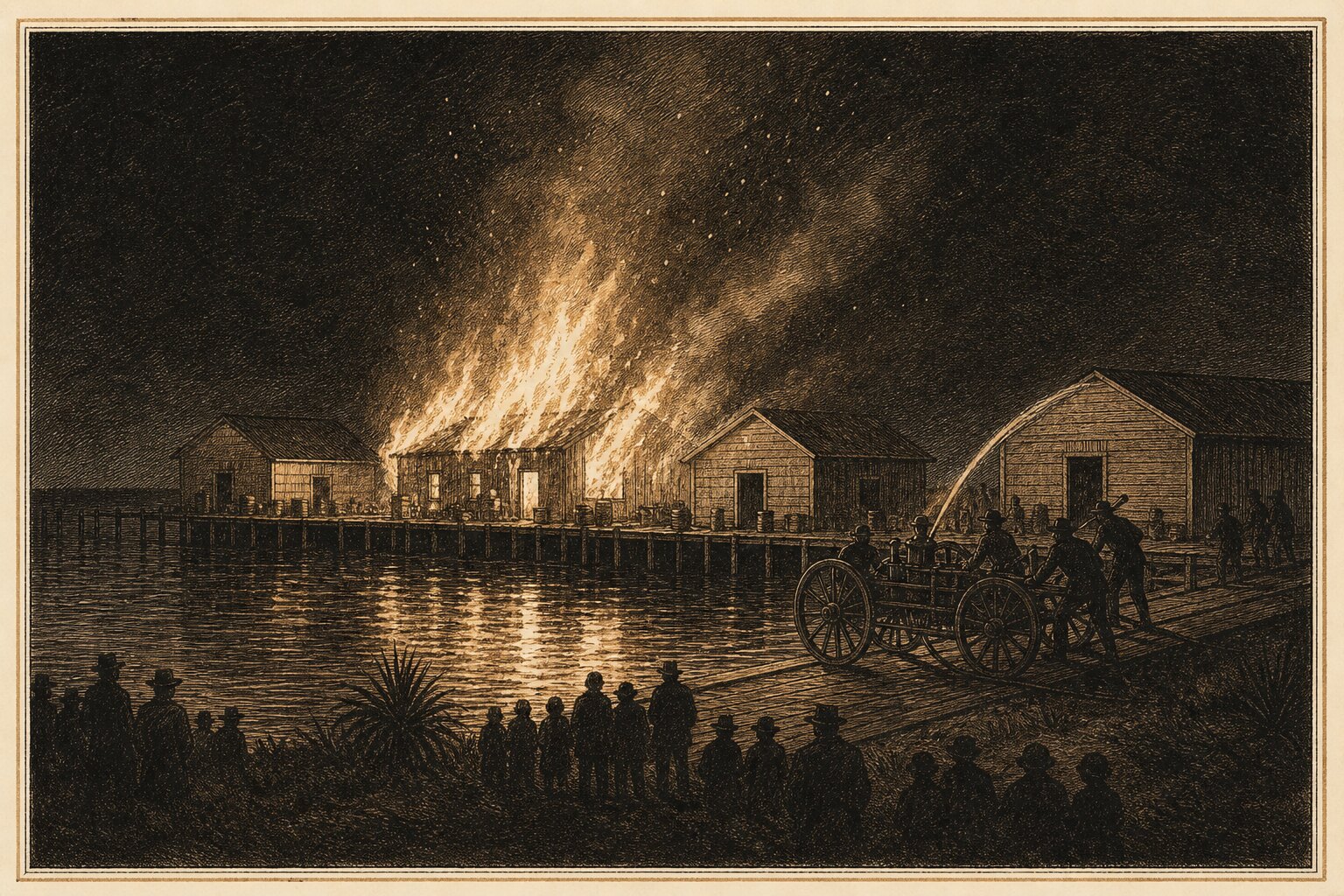
At half past nine on the evening of Monday, August 29, 1910, the fire alarm brought the people of Fort Pierce out of their houses and down to the river shore. The wholesale fish house of Cross & Rutherford was already a mass of flame; the whole roof had gone up before the alarm was given. The fish houses stood on the dock a few feet apart, and beside the burning one were four more wholesale fish houses, a machine shop, and the oil and gasoline warehouse.
The property in the line of the fire was worth more than $60,000. Nobody knew how it started; the best guess was a smudge, a smoky fire left to smolder.
The engine came, and this time it came fast enough. A steady stream of salt water went onto the two buildings on either side of the fire. Both caught, many times over, and each time they were drenched and the flames put down. The fire was held to the one building it started in, and the dock was saved.
The gasoline warehouse held more than a carload of gasoline, and had it gone, the explosion might have carried the fire to the shore and into the town. The charred walls of the two neighboring buildings were left standing as witness to the work of the volunteer fire department and the more than a hundred citizens who turned out to help them.
The engine that had just saved the waterfront had been, since the day the city acquired it, the subject of general ridicule among the citizens. The Tribune, which gave this story its name, conceded the point in the same breath: the engine was too small for the town, and arrangements were already under way to get one run by power. But its work that night had paid its cost many times over.
The loss came to nearly $4,000. Cross & Rutherford bore most of it, about $3,000 in nets, twine, engines and office supplies.
The detail that stays with a reader is the motor boat engines. The firm had just overhauled and painted seven of them for the coming season. Three fell through the burning floor into the river, where the sudden cooling cracked their cylinder heads and made them a total loss; the other four could be repaired for about $30 apiece. The fire came at the worst possible time, with the season’s supplies just laid in and the busy months about to open. That seasonal rhythm, and the dock the fish houses stood on, belong to the larger story of the Fort Pierce fishing industry.
Two smaller items followed the main story. The merchant P. P. Cobb presented Chief Tylander with a check for $100 for the benefit of the department, and the check went into the bank to start a fund for the next time.
And the editor scolded the town for its slowness. On the night of the fire one man had pulled the engine from its barn to the railroad by himself before three others caught up and helped him get it to the wharf. The same column raised, again, the question of a public water supply and a sewer system, and observed that a petition calling for a bond election had been sitting with the city council for several months.
What the fire bought
The ridicule ended the way ridicule usually does, with a purchase for the Fort Pierce fire department. At a special meeting on the night of Friday, November 25, 1910, the city council bought a gasoline-powered fire engine from the Howe Fire Engine Company of Indianapolis, together with a thousand feet of hose. The Tribune called it a splendid investment. Two weeks later, on Friday, December 9, the Fort Pierce fire department held a practice drill on Palmetto Avenue, and the paper judged that both the new engine and the men handling it had proved themselves.
On New Year’s Eve the town danced for them: the Firemen’s Ball at the Improvement Club hall on Saturday, December 31, was a benefit for the department.
One later call was an anticlimax, and a good one. Early on Tuesday, June 6, 1911, the fire and engine whistles woke the town. A crowd gathered and headed for the engine, only to learn that the fire was in a box car that had come in on the freight train from the north. The car was moved to the water tank and the flames were put out.
By 1911 the town counted a volunteer fire department among the things it could boast of, alongside a ladies’ improvement club, a boat-building establishment and a Woodmen of the World lodge.
The waterfront the department saved is the same one that anchors historic downtown Fort Pierce. The water and sewer question the fire reopened did not go away either: by the end of 1911 the town was being asked to vote on bonds for waterworks, sewers and electric lights. For the wider sweep of the town’s story, see the Fort Pierce timeline and the rest of our historic events.
Sources
This story is drawn from the two Fort Pierce weeklies of the day, The St. Lucie County Tribune and the Fort Pierce News, digitized by the Library of Congress in Chronicling America and in the public domain. The night of the fire is told in the Tribune of September 2, 1910; the department’s founding in the issues of January 26 and May 11, 1906; the new engine and its first drill in the issues of December 2 and December 16, 1910.