Downtown Fort Pierce is one of the oldest commercial districts on Florida's Treasure Coast. Its streets trace the outlines of a story that begins with a military encampment on the banks of the Indian River during one of America's longest and most costly frontier wars, passes through the arrival of Henry Flagler's railroad, endures the devastation of hurricanes and the slow decline of mid-twentieth-century urban centers, and arrives at a modern renaissance that has restored much of the district's original character. To walk through historic downtown Fort Pierce today is to encounter the living architecture of nearly two centuries of Florida history.
Origins as a military fort
The settlement that would become Fort Pierce owes its existence to the Second Seminole War, fought between the United States Army and the Seminole people of Florida from 1835 to 1842. In January 1838, the Army established a small fortification on the western shore of the Indian River Lagoon, part of a chain of military posts stretching across the Florida frontier. The fort was named in honor of Lieutenant Colonel Benjamin Kendrick Pierce, a career Army officer who commanded troops in the region. Benjamin Pierce was the brother of Franklin Pierce, who would later become the fourteenth President of the United States.
The original fort was a modest stockade structure, designed as a supply depot and staging point for military operations against the Seminoles in the dense scrublands and hammocks of the Indian River country. Soldiers stationed at Fort Pierce endured brutal heat, mosquitoes, and the constant threat of ambush. The fort saw limited direct combat but served a critical logistical function in the Army's strategy of establishing a network of posts to restrict Seminole movement and force their eventual surrender or removal.
What was the Second Seminole War?
The Second Seminole War (1835–1842) was the longest and most expensive of the Indian Wars fought by the United States. It was triggered by the federal government's attempt to forcibly relocate the Seminole people from Florida to Indian Territory (present-day Oklahoma) under the terms of the Treaty of Payne's Landing (1832). The Seminoles, led by figures such as Osceola, resisted removal through guerrilla warfare in the swamps and forests of Florida. The war cost an estimated $40 million and the lives of more than 1,500 American soldiers. Most Seminoles were eventually relocated, though a small group remained in the Everglades, and their descendants form the Seminole Tribe of Florida today.
After the war ended, the fort was abandoned, and the site returned to relative obscurity. For decades, the Indian River shoreline where the fort had stood remained sparsely populated, visited mainly by fishermen, hunters, and the occasional homesteader drawn by the fertile soil and abundant marine life of the lagoon. The area that is now St. Lucie County was still part of Brevard County, a vast and largely unsettled stretch of Florida's Atlantic coast.
The railroad era and the birth of a town
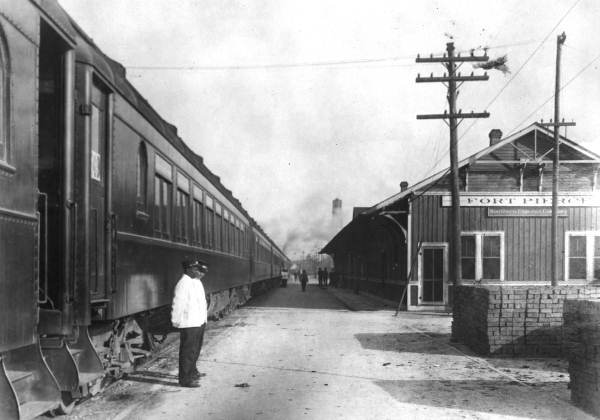
The transformation of Fort Pierce from a forgotten military site to an actual town began with the arrival of Henry Flagler's Florida East Coast Railway. Flagler, the Standard Oil co-founder who had turned his fortune toward developing Florida's east coast, extended his rail line southward from Jacksonville through the 1890s. The railroad reached the Fort Pierce area in 1894, and with it came everything a frontier settlement needed to become a proper town: reliable transportation to northern markets, a steady flow of new settlers, and a connection to the wider American economy.
The Fort Pierce train depot, built by the FEC Railway, became the nucleus around which the commercial district organized itself. Merchants, tradesmen, and professionals established businesses along what would become Second Street and Orange Avenue, the main arteries of the emerging downtown. The depot served not only as a passenger station but as the primary shipping point for the agricultural products that were becoming the economic foundation of the region. Pineapples grown along the Indian River were loaded onto railcars and shipped north, where they commanded premium prices in the markets of New York and Philadelphia.
The town of Fort Pierce was formally incorporated on April 17, 1901, with a population of roughly 300 residents. The incorporation marked the community's transition from an informal settlement to a self-governing municipality with its own elected officials, ordinances, and civic identity. Four years later, in 1905, the Florida Legislature created St. Lucie County by carving it out of the southern portion of Brevard County. Fort Pierce was designated as the county seat, a status it has held ever since, further cementing the downtown district's importance as the administrative and commercial center of the region.
Growth in the early twentieth century
The first years of the century were the years when Fort Pierce acquired a government. St. Lucie County was created in 1905 with the town as its seat, and it began with nothing to put a county in. That September the county still lacked a courthouse, a jail, a clerk’s office, even a safe place to keep the abstract books.
The town’s Improvement Club, a ladies’ civic society, had just built itself a hall, and in February 1906 the county commissioners rented it for the year as a courtroom. The circuit court convened there that month with Judge Minor S. Jones presiding, and between sessions the same hall held church suppers, bazaars and plays.
The downtown those courts sat in ran along Pine Street and Orange Avenue. By November 1909 the merchants had lit the main streets themselves, at their own small cost, until closing time every night.
The light in front of the Crystal Theatre lit Pine Street some distance to the south; the one at Tedder’s corner lit Orange Avenue from the railroad to the river; the lamps at the City Market, the Fort Pierce Drug Company and Faber Brothers’ corner, with several more on the east and south sides of the big Cobb store, lit the center of town and the walk to and from the depot. The town was not asked to vote on bonds for an electric light plant of its own until the end of 1911.
That was the year the town built. In June 1909 more than $60,000 of building contracts were in force at once, led by the county’s courthouse at $33,000, which had broken ground the week before with a force of men grading the site and plaster sheds going up; the contractors expected to finish in eight months.
Second on the list was a concrete business block at the corner of Orange Avenue and Pine Street, to cost about $9,000, for which F. M. Tyler’s house had been moved fifty feet nearer the river to clear the lot. Behind the Carlton building on Pine Street a contract had been let for an electric theatre seating five to seven hundred, with elevated seats. The Bank of Fort Pierce was adding a cement-block wing for its growing business, and a two-storey building was going up beside the St. Lucie Drug Store with a barber shop on the ground floor.
The Crystal Theatre opened on Pine Street on Tuesday, October 12, 1909, with moving pictures and music for two nickels. By 1911 it was open four nights a week, Tuesdays, Thursdays, Fridays and Saturdays, from seven to ten, and it served as the town’s hall as much as its picture house. The St. Lucie County High School held its commencement there on the evening of Friday, May 19, 1911, the first time the Fort Pierce school had carried a pupil through a full four-year high school course, and the president of Rollins College was to give the address. That Thanksgiving local players staged a four-act society drama, All for Her Sake, on its stage.
The courthouse rose on its lot near the river. The cornerstone was laid with Masonic ceremonies on the afternoon of Wednesday, September 22, 1909, with the two hundred and fifty pupils of the Fort Pierce High School and as many citizens marching to the site; into the stone went a list of the county and city officers, copies of both local newspapers, a Florida Citrus Exchange contract, a half dollar and a penny.
That same month the Boosters Club, with money raised by a ladies’ soliciting committee, accepted the county commissioners’ offer and secured a $750 clock for the tower. The county settled with the contractor in January 1910, and on Tuesday, February 15, 1910, the circuit court sat in the new building for the first time, with scores of visitors taking their first look at the completed courthouse. When the News listed the town’s assets in 1911 it called it the finest court house on the East Coast.
Down at the water the town’s business was fish and boats. The Cobb dock, already six hundred feet long, was extended in the summer of 1909 to make it, by the News’s reckoning, the longest dock on the Indian River, with new fish houses to be built on the extension. The Cobb and Sample docks were the largest on the shore, more than sixty launches and boats could be counted near them on any rest day, and the Cobb dock was the whole town’s promenade on Sunday afternoons. A track for fish trucks ran from the east end of the dock to the freight depot.
The Fort Pierce Hotel stood on the bank of the river; offered for sale in 1907 as plastered and modernized in every particular, it opened under F. M. Tyler’s management in January 1910. The dock and its fish houses have their own chapter in the story of the fire of August 1910, when a fish house burned and the rest of the waterfront was saved.
In September 1911 the News printed the town’s inventory of itself: six fish houses, two banks, seventeen stores, two newspapers, two telephone systems, cement sidewalks, automobile garages, a volunteer fire department, a ladies’ improvement club, and the division headquarters of the Florida East Coast Railway. The two banks were the Bank of Fort Pierce, in business by 1905, and the St. Lucie County Bank, open by 1908. It is a booster’s list and reads like one, the town’s own account of itself at the end of its first decade as a county seat.
These years are drawn from the two Fort Pierce weeklies of the day, digitized by the Library of Congress in Chronicling America: the Tribune of February 16, 1906 (the club hall as courtroom), June 11, 1909 (the building season) and September 17, 1909 (the cornerstone and the clock); and the News of October 8, 1909 (the Crystal Theatre opens), November 12, 1909 (the merchants light the streets) and September 8, 1911 (the town’s inventory).
The Florida land boom of the 1920s brought another surge of growth. Developers, speculators, and new residents poured into communities up and down the coast, and Fort Pierce was no exception. New commercial buildings rose along Second Street, many of them built in the Mediterranean Revival and vernacular commercial styles that were popular throughout Florida during the boom years. The P.P. Cobb Building, a handsome masonry structure on Orange Avenue, became one of the most recognizable landmarks of the downtown district, serving variously as a department store, offices, and a gathering place for the community.
The citrus industry was also expanding dramatically during this period. Indian River citrus, grown in the groves that surrounded Fort Pierce and neighboring communities throughout St. Lucie County, had earned a national reputation. The citrus packing houses that operated in and around downtown Fort Pierce were among the largest employers in the area, and the seasonal rhythm of the citrus harvest shaped the economic and social life of the entire community. The wealth generated by citrus, along with fishing, cattle ranching, and the burgeoning tourist trade, financed much of the construction that gave downtown Fort Pierce its distinctive architectural character.
The Sunrise Theatre
No building better represents the ambitions of early twentieth-century Fort Pierce than the Sunrise Theatre. Constructed in 1923 at 117 South Second Street, the theater was designed as a venue for both vaudeville performances and the new medium of motion pictures. Its Mediterranean Revival facade, with its decorative parapet and ornamental detailing, announced that Fort Pierce was a town that took its cultural life seriously.
For decades, residents of Fort Pierce and the surrounding communities gathered at the Sunrise Theatre for movies, live performances, community events, and the shared social experience that a downtown theater provided in the era before television and suburban multiplexes. The theater's name reflected one of the city's most enduring nicknames: Fort Pierce has long been known as the Sunrise City, a reference to its position on Florida's east coast, where spectacular sunrises over the Atlantic Ocean greet residents each morning.
The Sunrise Theatre closed in 1983, a casualty of the same forces that were hollowing out downtown districts across America: suburbanization, the rise of shopping malls, and the migration of entertainment to multiplex cinemas on the outskirts of town. For more than two decades, the darkened theater stood as a silent reminder of downtown's former vitality. Its eventual restoration and reopening in 2006, after a $20 million renovation campaign led by local preservationists and government officials, marked a turning point in the revitalization of historic downtown Fort Pierce. Today, the Sunrise Theatre operates as a 1,200-seat performing arts center hosting concerts, theatrical productions, and community events.
Avenue D
Any honest account of downtown Fort Pierce must include the story of Avenue D, which served as the heart of the city's African American community from the early twentieth century through the civil rights era. Like many Southern towns, Fort Pierce was a racially segregated city, and Black residents were largely confined to a designated commercial and residential district centered on Avenue D, north of the white downtown business district.
Despite the injustices of segregation, Avenue D became a self-sustaining community. Black-owned businesses, including grocery stores, barbershops, restaurants, funeral homes, and professional offices, lined the street. The Lincoln Theatre, the Black counterpart to the Sunrise Theatre, provided entertainment and a social gathering place. Churches, fraternal organizations, and community groups formed the institutional backbone of the neighborhood.
Fort Pierce's African American community produced notable figures who made lasting contributions to American culture and thought. The author and anthropologist Zora Neale Hurston spent the final years of her life in Fort Pierce, working as a substitute teacher at Lincoln Park Academy and writing for the Fort Pierce Chronicle before her death in 1960. Hurston, whose novels and folklore collections are now widely read and taught, was buried in an unmarked grave in Fort Pierce's Garden of Heavenly Rest cemetery.
In 1973, the writer Alice Walker traveled to Fort Pierce to locate Hurston's grave and placed a marker there, helping to spark the rediscovery of Hurston's literary legacy. Today her house on School Court is on the National Register of Historic Places, and the Dust Tracks Heritage Trail links the sites of her Fort Pierce years.
The civil rights movement of the 1950s and 1960s brought significant changes to Fort Pierce, as it did to communities across the American South. The desegregation of public facilities, schools, and businesses gradually dismantled the legal framework of segregation, though the social and economic legacies of that era continued to shape the city for decades. The history of Avenue D remains an essential chapter in the story of downtown Fort Pierce, a reminder that the city's heritage belongs to all of its communities.
Hurricanes and hardship
Downtown Fort Pierce has weathered literal storms as well as economic ones. The 1928 Okeechobee Hurricane came ashore fifty miles to the south on September 16, 1928, after a day of hurricane warnings along this coast; its worst fell at Lake Okeechobee, where about two thousand people drowned. The hurricane, combined with the collapse of the Florida land boom and the onset of the Great Depression, plunged the region into years of economic hardship.
The community rebuilt, and the arrival of military installations during World War II brought a new economic boost. The Navy established its Amphibious Scout and Raider training program and later its Naval Combat Demolition Unit training on the beaches of nearby Hutchinson Island in 1943. Thousands of servicemen passed through Fort Pierce during the war years, and downtown businesses benefited from the military payroll. The frogmen who trained on Fort Pierce's beaches would become the predecessors of today's Navy SEALs, a legacy commemorated at the National Navy UDT-SEAL Museum on North Hutchinson Island.
Decline and the push for revitalization
The postwar decades brought prosperity to Fort Pierce as a whole but posed challenges for the traditional downtown. As in countless American cities, the construction of suburban shopping centers, the widening of highways, and the outward migration of residents and businesses eroded the economic base of the historic core. By the 1980s, many downtown storefronts were vacant, and the district had lost much of its commercial vitality.
The effort to reverse this decline began in earnest in the 1990s and gained momentum through the 2000s. The restoration of the Sunrise Theatre was a catalytic project, demonstrating that investment in downtown could yield returns in both economic activity and community pride. The establishment of the Fort Pierce Farmers' Market, held each Saturday morning along the waterfront, brought residents and visitors back to the downtown streets. Public art installations, streetscape improvements, and the development of a marina and waterfront promenade along the Indian River Lagoon further enhanced the district's appeal.
Local government and preservation organizations worked to secure historic designations for key downtown buildings, providing access to tax credits and other incentives for restoration. The Main Street Fort Pierce program, affiliated with the National Trust for Historic Preservation's Main Street America initiative, coordinated revitalization efforts and promoted the district as a destination for dining, shopping, arts, and culture. Galleries, restaurants, and small businesses moved into restored historic buildings, giving downtown a new economic identity rooted in its architectural heritage and waterfront setting.
Downtown Fort Pierce today
Historic downtown Fort Pierce today is a compact, walkable district centered on the intersection of Orange Avenue and Second Street, extending to the waterfront along Indian River Drive. The architectural landscape is a layered record of the city's history: the Mediterranean Revival facades of the 1920s stand alongside vernacular commercial buildings from the early 1900s and more recent infill construction. The Sunrise Theatre anchors the cultural life of the district, while the waterfront provides a scenic backdrop for public events and daily life.
The Fort Pierce Farmers' Market, operating since 1999, draws thousands of visitors each weekend. The market features local produce, seafood, baked goods, and artisan crafts, connecting contemporary Fort Pierce to the agricultural traditions that have sustained the community since the pineapple and citrus eras.
Downtown Fort Pierce remains the county seat of St. Lucie County, and government offices, the county courthouse, and civic institutions continue to anchor the district. The interplay of history, commerce, culture, and civic life that has characterized downtown Fort Pierce since the early 1900s endures, even as new chapters are written. For residents and visitors alike, the historic downtown is the place where the story of Fort Pierce is most tangible, most layered, and most alive.
Frequently asked questions
When was Fort Pierce founded?
Fort Pierce originated as a military fort established in January 1838 during the Second Seminole War. The town was formally incorporated on April 17, 1901. St. Lucie County was created in 1905 with Fort Pierce as the county seat.
Who was Fort Pierce named after?
Fort Pierce was named after Lieutenant Colonel Benjamin Kendrick Pierce, a U.S. Army officer who commanded troops in the area during the Second Seminole War. Benjamin Pierce was the brother of Franklin Pierce, who served as the fourteenth President of the United States from 1853 to 1857.
What is the Sunrise Theatre?
The Sunrise Theatre is a historic performing arts venue located at 117 South Second Street in downtown Fort Pierce. Originally built in 1923 as a vaudeville and movie palace, it closed in 1983 and was restored and reopened in 2006 after a $20 million renovation. It now serves as a 1,200-seat performing arts center.
Why is Fort Pierce called the Sunrise City?
Fort Pierce is known as the Sunrise City because of its location on Florida's east coast, where residents enjoy dramatic sunrises over the Atlantic Ocean. The nickname has been in use since at least the early twentieth century and is reflected in local landmarks such as the Sunrise Theatre.
What was Avenue D in Fort Pierce?
Avenue D was the center of Fort Pierce's African American commercial and social life during the era of segregation. It was home to Black-owned businesses, the Lincoln Theatre, churches, and community institutions. The author Zora Neale Hurston spent her final years in the neighborhood.
When did the railroad arrive in Fort Pierce?
Henry Flagler's Florida East Coast Railway reached the Fort Pierce area in 1894. The railroad's arrival connected the settlement to northern markets and enabling the growth of the pineapple and citrus industries that would define the regional economy.