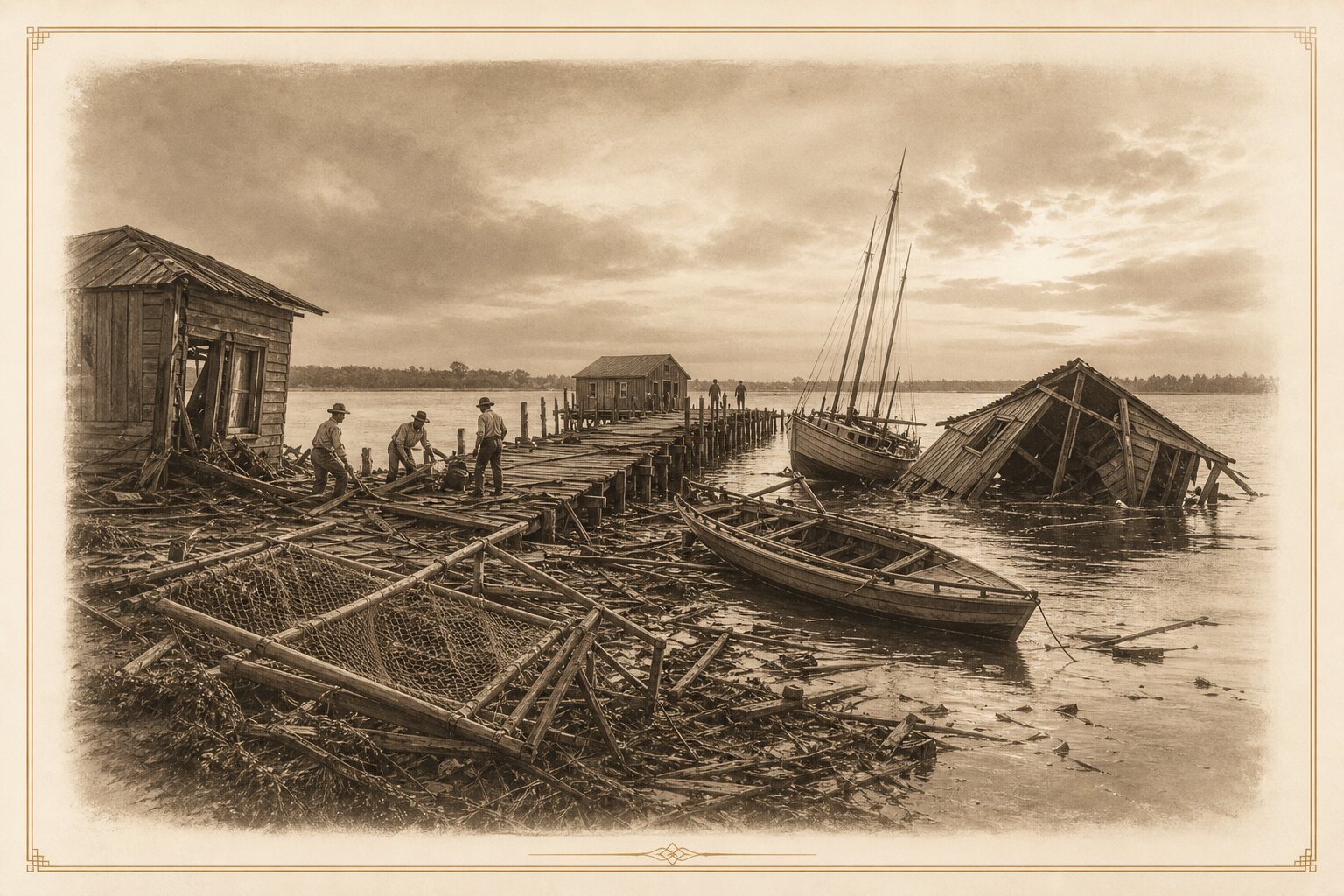
Fort Pierce met the hurricane of 1910 with its money on the water. The wharfs ran out from the shore into the Indian River with the fish houses on them, the boats tied up alongside and the nets on racks to dry, and behind them on the bank stood the boathouses, a bottling works and a contractor’s buildings. A hurricane on the Indian River is a waterfront event before it is anything else. This was the storm the town met head-on; the year before, it had met the other kind, the storm that stops at Miami.
A cloudy day and a four-mile breeze
On Monday, October 11, 1909, a hurricane that had been hovering near Key West broke over the city in full fury and left it a mass of wreckage. The Fort Pierce papers had the story by Friday, in pieces.
The hurricane had lasted at Key West only forty-five minutes, but in that time it had destroyed more than two million dollars of property, including ten of the largest cigar factories, and left thousands homeless, with no lives reported lost there. Below Miami it had torn up four thousand feet of the Florida East Coast Railway’s Key West extension between Jewfish and Manatee creeks, destroyed half the dock at Knights Key and sunk all the dredges and pile drivers. A man was drowned at Marathon, the tug Sybil was sunk, and a captain and his crew of ten were drowned; the tug Sadie was lost and her crew saved.
None of it reached Fort Pierce. The storm did not extend north of Miami. In Fort Pierce the wind on Monday did not get above four miles an hour, and but for a cloudy day and a breeze before daylight there was no sign of a storm anywhere.
The Tribune’s editorial page drew the moral its readers wanted. The East Coast was still on the map, thanks to a kind Providence. The hurricane had merely touched the extreme south end of the coast, the reports of devastation along the whole coast had been the wildest guess, three-quarters of the East Coast had not known a storm was raging except from the government reports, and even then a large number of citizens felt that the Weather Bureau had missed its guess again. Fort Pierce, in the middle of the supposedly devastated region, had enjoyed a cloudy day with an occasional shower and the usual four-mile breeze.
The county gave what it could to the people who had been hit. At Jensen the regular ball team played a picked nine styled the Hurricane Team on a Tuesday afternoon and sent the gate to Key West for the storm sufferers, and the railroad’s roadmaster went south to look over the damage to the extension, which the company’s vice-president called the greatest property loss it had ever had.
The warnings
The next October the warnings came five days ahead of the wind. The Tribune had just printed an argument that cited the Bureau’s daily reports to show a Florida summer more endurable than one in Minnesota or the Dakotas. Then, on Wednesday, October 12, 1910, word went out that a hurricane which had formed to the southeast of Cuba had wrought havoc at Santiago, curved around the island and was making for Key West.
The tail of it struck Fort Pierce on Thursday, and from Thursday until Sunday afternoon the section was held in the grasp of a perfect deluge. On Sunday the storm slackened, and the reports from the government weather station said the hurricane had recurved and was headed for the Louisiana or Texas coast.
Hardly had the news of the recurve gotten to the ears of the people before a second report gave warning of a second hurricane, formed south of western Cuba and headed directly north, which was then playing havoc in Havana and would sweep the entire East Coast. The rain kept pouring, and the wind rose.
The hurricane of 1910: Monday night, October 17
The wind reached hurricane proportions on Monday night, October 17. The barometer stood at 29.17, and between two and four on Tuesday morning conditions were at their worst, the rain falling in torrents and the wind reaching seventy miles an hour at times. At ten on Tuesday morning the barometer began to rise, and by four in the afternoon the storm had passed.
The rain did the damage inland. It washed out the Florida East Coast Railway’s track first at Jupiter and then at Rio, stopping all traffic south of Fort Pierce on Tuesday; washouts north and south of Titusville tied up the trains in both directions all day Wednesday, and mail and telegraph were cut until Thursday morning. Farm lands, county roads and bridges took great damage from the rainfall.
The wind did its work on the river front, where it demolished wharfs, boathouses, fish-net stands and boats. In Fort Pierce the wharfs and boathouses of E. C. Summerlin and F. M. Tyler were demolished, and their wreckage tore great holes in the wharfs of P. P. Cobb and the Indian River and Lake Worth Fish Company and wrecked the buildings of Roylance and Horton, contractors, and the Fort Pierce Bottling Works, which stood on the shore.
By the town’s own reckoning it was the worst weather the southern East Coast had ever had: considerable damage all along the line from wind and water on the river front and from the overflow of farm lands, and no devastation. Repairs began as soon as the storm was over.
Sixty coaches in the yards
With the track gone at Jupiter and Rio, everything bound south stopped at Fort Pierce. No train could run south of the town after Saturday, and on Monday traffic to the north stopped too. For the first three days of the week the town was crowded with storm-bound passengers off the Florida East Coast Railway. As many as sixty passenger coaches, many of them full of tourists from the west, stood in the local yards, and every spare room in town was taken.
A West Palm Beach man among them spent his first hours in town searching for his wife, who had come down from Jacksonville on an earlier train and got as far as Stuart. Travelers home from a wedding in Tampa waited as house guests for the line to Miami to reopen. Work on the railroad improvements in town, begun the Friday before, stopped on Saturday when the crews were sent south to mend the track.
The first mail since Monday night arrived on Thursday morning. With the wires down all over the state, the only news of the rest of Florida came by wireless from Tampa and Key West and from the ships in Tampa Bay: the southern and eastern sections of the peninsula swept, damage severe, no loss of life reported, Jacksonville a tangled mass of wires and awnings.
Three motor boats from Fort Pierce went down to West Palm Beach after the storm, came near grief in the rapids that had formed at the entrance to Lake Worth, and were the first means of communication to reach that town. On the Sunday after, the Presbyterians, meeting in the Improvement Club hall, heard an evening sermon on A Shelter From the Storm, and the Baptists a morning one on In the Teeth of the Storm.
Up and down the river
The river towns sent in their damage with the next week’s correspondence. At Stuart several docks washed away and not much else, and the Christian Endeavor rally was put off a month. At Sebastian a kitchen went off its blocks on the Tuesday of the storm.
At Eden, where the sun had been hidden for four days that seemed like a month, the storm twisted limbs off the trees and uprooted a few, carried away several boat landings and sank a few boats, and beat the fruit off the trees, which was the greatest loss of all; the correspondent counted the place fortunate and on the whole glad of the storm for clearing the air and winding up the gale season.
At Walton, which came through two gales and a hurricane without great damage, a boathouse that had stood white at the end of a wharf, visible for miles up and down the river, took wing in its owner’s absence and set itself down on a neighbor’s lawn. The Inn there lost a large part of its rubber roofing and took a deluge through three floors of rooms, the Mizpah was the only launch to go to the bottom, and the motor boats and sea skiffs of the Walton Fish Company rode the storms out in a marvelous manner.
East Coast Lumber and Supply asked its customers’ indulgence if shipments were delayed: the storm had cost it serious damage and heavy financial loss. A month later a Sebastian man was still advertising for a launch missing since the storm, nineteen feet, round-bottomed, painted green, with a three and a half horsepower engine.
At the south end of the county the storm did a little of what Congress would not. By the reports that reached Fort Pierce it had widened and deepened the St. Lucie Inlet, to the benefit of the fishing industry, which the town’s paper counted an ill wind blowing somebody good.
A flagstaff for the town
A week after the storm, on the evening of Monday, October 24, about thirty members of the Board of Trade met in the county courthouse with A. D. Penney presiding. It was the kind of meeting a town holds when it has just been reminded what it lacks.
James E. Andrews laid out the Florida East Coast Realty Company’s plans for a large tract northwest of town and got a committee to look into them. Another committee was to draft resolutions asking the Florida East Coast Railway to make Fort Pierce the terminus of the line it was reported to be planning south through the Fort Drum ridge to Lake Okeechobee, and to send them to Mr. Flagler. A committee of three was set to getting the Western Union a telegraph office of its own, independent of the railroad’s.
Another committee was to assure the city council of the Board’s hearty cooperation in getting the town better fire protection, two months after the fish house fire. And on a motion unanimously carried, T. J. O’Brien, R. Whyte and H. E. Crooks were appointed to draft resolutions showing the need of storm signals and asking the Weather Bureau to erect a flagstaff in Fort Pierce and equip it for service.
The resolutions were printed a month later, on November 25, as a petition to the United States Weather Bureau for a flag pole in the city, and they put the case in dollars. The Bureau’s warnings of the West Indian hurricanes before their arrival had saved much property.
The principal industries at Fort Pierce were fishing, vegetable growing, citrus and tropical fruit. The fishing industry had about fifty thousand dollars invested at this point in boats, nets, racks and buildings in exposed places, all of it endangered when an unlooked-for storm came; being warned, the fish dealers around Fort Pierce had been able to save many thousands of dollars’ worth of property in the recent hurricane.
In winter the pineapple industry could largely escape a cold snap by fires, smudge pots and to some degree by covering, if warning came in time, and the pineapple region in close communication with Fort Pierce had about a million dollars invested that a hard freeze would wipe out with no protection. Truck farming had about a hundred thousand dollars in the ground, its success largely dependent on the weather, and timely warning of cold was the means of holding down the damage, by covering and fires beforehand and by preparing to replant afterward.
The Board of Trade therefore petitioned the Weather Bureau to erect a flag pole at Fort Pierce for the use of the displayman in displaying the signals and giving the warnings the Bureau sent out so efficiently, and asked that a copy be forwarded to the proper authorities.
What the town had, and what it wanted
The petition was not for a thermometer. Fort Pierce had had a cooperative observer of the Weather Bureau for years: the News had been printing his weekly table of temperatures and rainfall since at least the summer of 1908, over the name of R. L. Goodwin, and by 1911 the observer was T. C. Nicholson. What the town could not do was show a warning. The Bureau’s storm flags needed a pole and a man to run them up, and the Board asked for both.
In December 1911 the Weather Bureau announced a new signal, the small craft warning, a red pennant flown by day when the wind would not justify a regular storm warning but would interfere with the safe operation of fishing boats and motor boats. It was to be displayed at Fernandina, Mayport, St. Augustine, Daytona, Jupiter, West Palm Beach, Cedar Key, Punta Gorda and Punta Rassa, and probably, the notice said, at Titusville, Eau Gallie, Fort Pierce and Fort Myers.
The town’s next great storm was of another order altogether, and the page on the 1928 hurricane tells it. The fish houses and wharfs the wind wrecked belong to the story of the Fort Pierce fishing industry, the courthouse where the Board of Trade met to the story of historic downtown Fort Pierce, and the wider sweep of the town’s years to the Fort Pierce timeline and the rest of our historic events.
Sources
This story is drawn from the two Fort Pierce weeklies of the day, The St. Lucie County Tribune and the Fort Pierce News, digitized by the Library of Congress in Chronicling America and in the public domain. The Key West storm of 1909 is in the Tribune of October 15, 1909, its editorial page and the News of the same date; the hurricane of 1910 and the week the town filled up are in the Tribune of October 21, 1910 and its local page.
The river towns and the Board of Trade meeting are in the Tribune of October 28; the petition in the Tribune of November 25, 1910; the weekly weather table in the News of September 11, 1908 and April 14, 1911; and the small craft warning in the Tribune of December 8, 1911.