Fort Pierce Farms was a large tract of land at the edge of Fort Pierce, owned by the Florida East Coast Realty Company and put on the market early in 1911. For about a year the town’s two weekly papers followed it closely: the visitors who came to look, the farms that sold, and the big drainage ditch that was supposed to make the land dry for good. This page follows the tract through those papers, which end in December 1911. What became of the farms after that is not in them.
Where the tract lay
The land lay north and northwest of town. One corner came within a quarter of a mile of the city limits, and from there the tract ran about six miles north, parallel with the Indian River and fronting on the Florida East Coast Railway to a point above Viking station. It was some nine miles across from east to west, and on its eastern side it met the pineapple ridge. The Tribune put the whole at 36,000 acres. That spring an advertisement for lots on Orange Avenue called it the main road to Fort Pierce Farms.
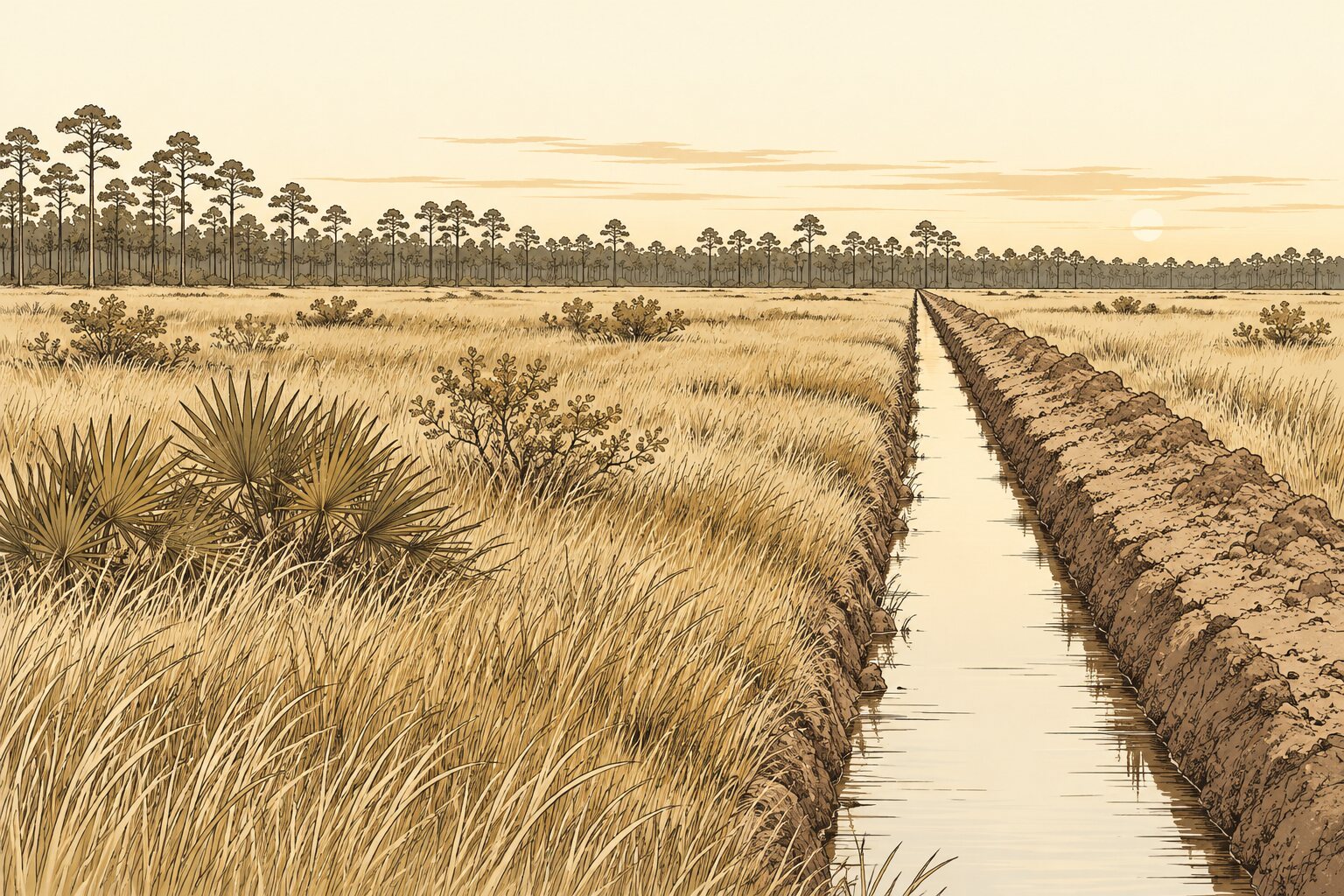
Much of it was prairie. A newspaperman who drove out with a party in February 1911 described standing at the edge of one of the large prairies and looking across a level expanse of waving grass, dotted with clumps of palmetto or willow, with a fringe of heavy pine timber around each. The soil was called a black loam over clay and marl. The timber lands, said to hold several million feet of lumber, were held back from sale.
Fort Pierce Farms goes on the market, 1910 and 1911
The first visitors came in December 1910. A Jacksonville timber man who ran five mills spent two days looking over the timber holdings, and a real estate man from Clarksburg, West Virginia, came down to inspect the property west of town. In January 1911 the realty company brought out a booklet, twenty-eight pages, eight by ten inches, with twenty-seven halftone pictures of scenes in and around Fort Pierce. The Fort Pierce News praised it as an advertisement for the whole town.
The tract was platted into forty-acre farms, and the first hundred went on sale at $30 an acre. By March 1 eighty-four of them had been sold, many to people from Fort Pierce itself, by the papers’ reports. The company sold with a drainage guarantee, and the drainage was the part everyone watched.
The plan for the ditch
The plan was two main canals fed by smaller laterals, laid out so that a canal ran along one side of every forty acres, with the surplus water carried off to the Indian River. In April 1911 the plan came back approved by the chief of drainage investigations at the U.S. Department of Agriculture, who reported that the system would carry off the surplus water even in a flood like the one the area had seen the October before. Some had criticised the company for moving slowly, but it had held to taking its time to get a system that would keep the land dry at all times.
By the middle of May the right of way for the canals was cleared. The main canal was to empty into Taylor Creek.
The excavator arrives, June 1911
The machine came by rail. A large excavator arrived on Sunday, June 4, 1911, and the next day the railway’s wrecking outfit unloaded it onto a temporary track, so that it could run out to the work under its own power.
By July the digging had started at Taylor Creek, heading northwest for half a mile and then west. The man superintending the work had come from a job on one of the dredge boats in the Everglades. Two gangs worked the job: one clearing the right of way of trees and other obstructions the excavator could not handle, the other on the machine itself, which ran in two shifts, day and night. The camp, the Tribune said, was being visited by many residents of the city.
Fort Pierce Farms at work, August 1911
In August the company’s sales agent drove a reporter over the tract by car and out to the excavator. The main ditch was being cut twenty feet wide at the bottom, its sloping sides widening to as much as forty-five feet at the top, and the machine was moving about a thousand cubic yards of earth every twenty-four hours. Where the ditch met Taylor Creek the company had built a concrete dam with wing walls, some forty feet across overall, its foundation sunk five feet below the ditch bed, and it was widening the creek to carry the whole flow down to the Indian River. With its laterals, the headline said, the main waterway would run to thirty miles.
The paper described the machine as well: an engine on a revolving base mounted on a short section of track, swinging a long steel beam from which the digging bucket hung on steel cables.
Where the record ends
The work was still going on that fall. In October the man in charge of the drainage project spent several days in town, and the Tribune reported that the work was going forward in a satisfactory manner: the excavator was running day and night shifts, the drainage crews were to be largely increased, and three more machines had been ordered. The last issue in the record, on December 29, 1911, carried on its front page a letter to the company dated at Jensen, praising the land and noting how many unwarranted claims were being made in the sale of Florida lands.
That is where the digitized papers stop. Whether the ditch drained the prairie as promised, and who farmed the forty-acre lots, lies past 1911 and outside these sources. For the town the farms were sold from, see Fort Pierce in 1910, which counts three real estate agencies in 1909; for the ridge on the tract’s eastern edge, see our history of the pineapple industry.
Sources
This page is drawn from the two Fort Pierce weeklies of the day, digitized by the Library of Congress in Chronicling America and in the public domain. From The St. Lucie County Tribune: December 16, 1910, page 1; March 24, 1911, page 2; March 31, 1911, page 1; April 7, 1911, page 1; May 19, 1911, page 4; July 14, 1911, page 1; August 18, 1911, page 1; October 13, 1911, page 1; and December 29, 1911, page 1.
From the Fort Pierce News: January 20, 1911, page 1; March 3, 1911, page 1; June 9, 1911, page 1; and October 6, 1911, page 5.