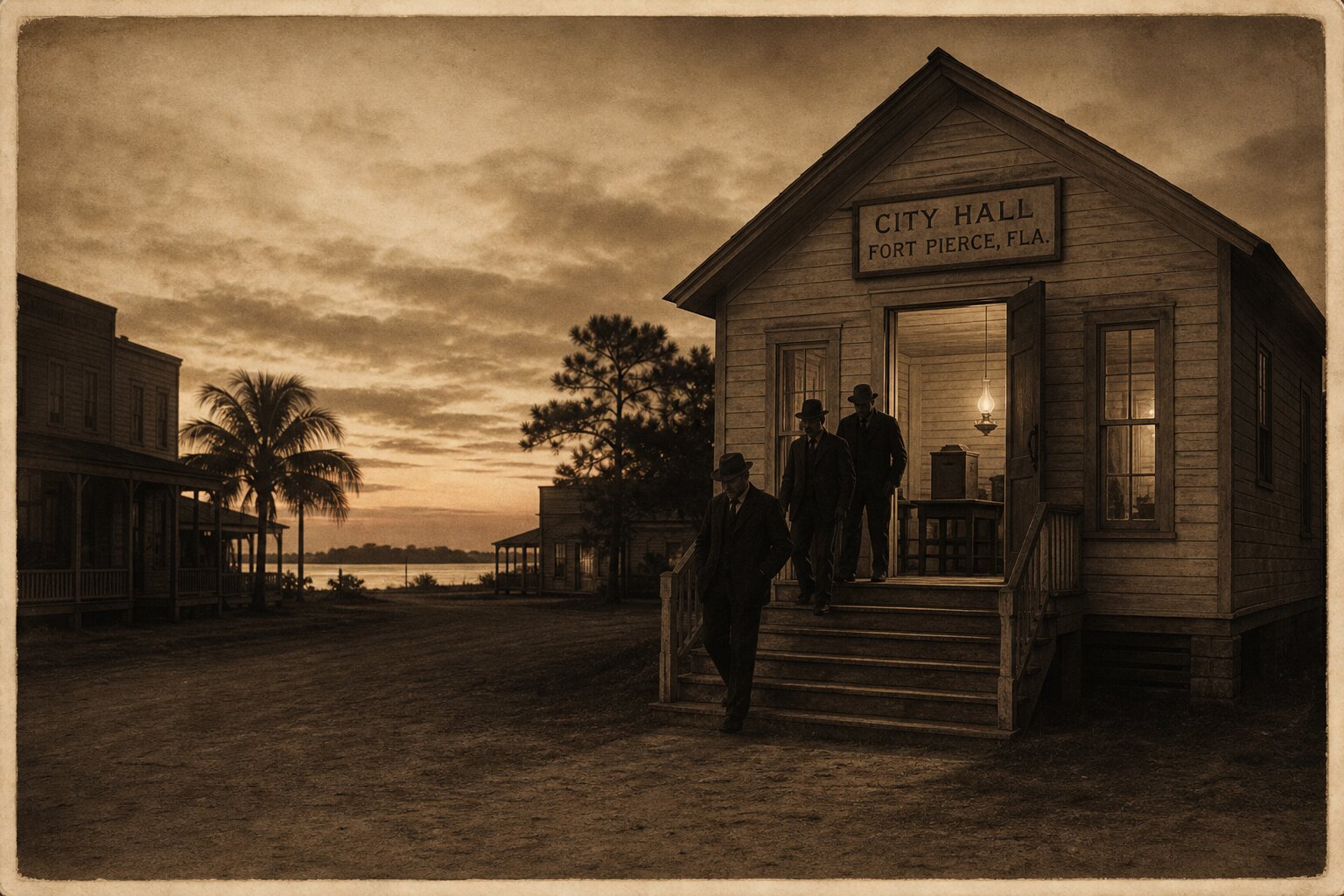
Fort Pierce voted for its own water works, sewers and electric lights on Tuesday, December 12, 1911, and it did so without a single vote against. Seventy-six of the town’s eighty-two qualified voters came to the City Hall that day, and every one of them marked the ballot for $90,000 of thirty-year bonds.
It was the town’s second vote on the question of light. The first, two years earlier, had gone the other way, and the road from one to the other runs through a franchise that argued about the moon, a State Health Officer’s letter about typhoid, and a Board of Trade meeting in the new courthouse.
A light company on paper
The town had an electric light company before it had an electric light. When the ice factory stood half built in the summer of 1905, with the material on the ground and the framing not yet up, the delay was a matter of paper. The new owners had bought the property from the East Coast Electric Light, Power and Ice Company, a concern with headquarters in Newark, New Jersey, whose president had lately died, and no work had been done since the last Saturday in July while the deal waited to be formally closed.
The ice came. The light did not. By 1909 the ice factory belonged to the St. Lucie Ice Company, and the company’s president was the mayor of Fort Pierce, R. Whyte.
The franchise and the moon
In the spring of 1909 the city council took up an ordinance giving the St. Lucie Ice Company a thirty-year franchise to light the town. The Tribune, which wanted a plant the town would own, said it regretted that the town’s immediate needs made a private franchise necessary, and it picked at the draft: as written, the company alone would decide when the moon was bright enough to leave the street lamps dark.
The ordinance the council introduced on Wednesday evening, June 2, and printed in full in both papers that Friday, answered the objection with a city official whose duty it would be to judge the darkness and order the lamps lit.
Its other terms show what the town was buying. The company would light the streets from dark until daylight except on moonlit nights, and the city would pay for at least two arc lights of two thousand candle power at $90 a year apiece and twenty smaller tungsten lamps at $45 a year, which came to $1,080 a year for twenty-two lights.
The rates would hold for ten years. The company had to have its plant running by January 1, 1910, or the franchise was void, and at the end of ten years, and again at twenty, the city could buy the plant at a valuation fixed by three arbitrators.
The council passed it on Tuesday evening, June 8, after adjourning a week so that the town could study the terms and object if it wished. Two citizens who were not members of the city government came. The changes made at the final reading bound the company to keep the plant in continuous operation and made the franchise itself worth nothing if the city ever bought the plant.
The company did not want it. At a special meeting on a Thursday afternoon in July the stockholders unanimously refused the amended franchise with its ten-year purchase options and said they would consider nothing less than a straight thirty-year grant. If they got that, they said, they would build a first-class plant and have it running by the first of January.
The council put the question to the voters. An election set for the middle of August did not take place, for reasons nobody could explain, and the vote was held instead at the council rooms on Tuesday, August 31, 1909, from ten in the morning until five in the afternoon. The straight thirty-year exclusive franchise lost, 44 votes to 21.
The Tribune read the result as a vote for a municipal plant and, in the same issue, proposed one: bond the city for $40,000 in four equal parts, for an electric light plant, a sewerage system, water works and streets. Nothing came of it that year.
That November the merchants of Pine Street and Orange Avenue lit the main streets themselves, as the page on historic downtown Fort Pierce tells, and in May 1910 the council gave R. Whyte leave to run an electric light wire along Palmetto Avenue from the ice factory to the river, and took the mayor’s offer of a free light for the council chamber if the city paid for the wire.
Typhoid is a tiny plant
The argument for water and sewers came from the State Board of Health. On January 20, 1911, the State Health Officer, Dr. Joseph Y. Porter, wrote from Jacksonville to Mayor Whyte on what he called the essentials of sanitation.
The Board was not trying to run the town’s affairs, he wrote; but a group of diseases travelled by sewage, typhoid fever at the head of the list with dysentery and hookworm behind it, and the open closet that served a scattered settlement well enough served a growing town only fairly well.
He offered Bartow as the lesson: a town that had put off a sewerage plant until its water supply was fouled, counted some 250 cases of typhoid fever, some of them among its leading citizens, and then built the plant readily enough. If Fort Pierce could see its way to bonds for water and sewerage disposal, he thought it would make no mistake.
Thirty men in the courthouse
On Monday evening, May 1, 1911, thirty members of the Board of Trade met in the courthouse to take up electric lights, sewers and water works. It was the same Board that had petitioned the Weather Bureau for storm flags after the hurricane of 1910, and its president, Judge A. D. Penney, put the question plainly as whether the city should bond for the three.
City Clerk F. M. Tyler reported that the new assessment roll would show a valuation of about $600,000, which under the charter would allow bonds as high as $150,000.
Deputy Clerk J. C. Roberts introduced J. E. Craig of Craig & Marshall, civil, electrical and consulting engineers of Port Gibson, Mississippi, with an office in Jacksonville, who had just finished building Green Cove Springs, a town the size of Fort Pierce, a $15,000 water plant, a $10,000 electric light plant and a $5,000 drain sewer. Sizing Fort Pierce by its dimensions, he thought $15,000 for a light plant and $25,000 for water works would give the town plants good until its population passed ten thousand, and after walking the streets on Tuesday morning he stood by the figures.
The resolutions Penney offered, adopted without a dissenting vote on J. K. Williams Jr.’s motion, said that the time had come for immediate and determined action to get water works, sewerage and electric lights; that the health of a fast-growing town demanded a complete system of water and sewers, and its beauty and convenience would be the better for electric lights; and that the Board favoured an election as early as practicable to decide whether the city should bond and for how much, in a sum ample to carry the works to every business and residence part of town.
A committee of three, C. M. Horton and J. K. Williams among them, was named to urge the council to hire an engineer at once for a survey, blueprints and estimates. The sum talked of was $80,000.
Two engineers and a message
In September Mayor Whyte sent the council a message on the same three necessities, under a charter that made it his duty to put recommendations on the public service before them. A water plant would cost about $35,000, a sewerage system $20,000 and an electric light plant $20,000, figures taken from Florida towns of the same size, and the works would earn more than enough to pay off the debt as it came due, so that the undertaking would be a revenue producer rather than an expense.
The people had a right to have their property protected from fire, a year after the fish house fire on the waterfront, a right to pure water and a right to a sewerage system for the health of the town, and he asked the council to find out from other cities exactly what the three would cost. The same message asked for a lot for a future City Hall and for better streets.
By the council’s October meeting two sets of figures were on the table. Rogers, a civil engineer of the Daytona firm of C. M. Rogers, had drawn plans for about five miles of water mains, wires and sewers, built to be up to date in every particular and to serve the town for years to come, and put the whole at about $80,000.
Craig & Marshall’s estimate came to $74,000: $35,000 for water, $24,000 for sewers, $12,400 for lights and $2,600 for incidentals, with the engineer’s fee in neither. Two estimates so close were taken as proof that $80,000 would do it, and the council adjourned to October 12 to sit with the city attorney and draw the call for an election.
Ordinance No. 28
The council passed Ordinance No. 28 in open session on Wednesday, November 1, 1911, with W. R. Jackson as president of the council and F. M. Tyler attesting as clerk, and Mayor Whyte approved it the same day. It called a special election for Tuesday, December 12, at the City Hall, before three inspectors and a clerk, on three separate questions: $45,000 of bonds for water works, $30,000 for a system of sewerage and $15,000 for electric light works, $90,000 in all, each to be marked for or against on its own line of the ballot.
The bonds would be of $500 each, dated January 1, 1912, bearing six per cent a year payable twice a year and due in thirty years, on the first day of January 1942, under the heading Public Utility Bonds, Issue of 1912.
Only qualified electors who owned real or personal property in the city and had paid their last city taxes on it could vote. The ordinance was printed in full week after week until the election.
The Tribune made its case for the bonds a week before the vote with an object lesson from Macon, Georgia, whose city-owned water works had cleared a net profit of about $1,400 in their first month under municipal ownership. There was no reason, it said, why Fort Pierce could not halve its tax rate and pay the expenses of the city government from the income of a light plant and water works of its own.
The Fort Pierce bond election of December 12, 1911
The vote was unanimous. Eighty-two voters were qualified under the property rule; seventy-six came to the City Hall on Tuesday, December 12, and when the polls closed and the ballots were canvassed every one had been cast for all three issues.
The Tribune reckoned that probably no election in America with as many as eighty qualified voters had ever gone that way, took the result as proof of the town’s claim to be the first little city of the land, and expected bonds carried like that to sell at a premium; it was now up to the council, it said, to lose no time.
Down the coast the West Palm Beach News ran a paragraph headed Bully for Fort Pierce, noting that the town had voted to spend $90,000 without a single knocker, and the Tribune reprinted it. The improvements, that paragraph said, were to be made at once.
The bonds were dated January 1, 1912, and what the $90,000 built is the next chapter of the town’s story.
The vote itself closed a six-year argument: from a light company that existed on paper in 1905, through the franchise the town would not give a private company in 1909, to a town that had decided by 1911 to own its water, its sewers and its lights, and said so seventy-six times over with no voice against. The wider sweep of those years is on the Fort Pierce timeline and in the rest of our historic events.
Sources
This story is drawn from the two Fort Pierce weeklies of the day, The St. Lucie County Tribune and the Fort Pierce News, digitized by the Library of Congress in Chronicling America and in the public domain. The ice factory and the light company on paper are in the Tribune of August 4, 1905; the franchise fight of 1909 in the Tribune’s editorial of April 23, the News of June 4 (the ordinance in full), June 11 (its passage) and July 23 (the stockholders refuse), and the Tribune of September 3, 1909 (the vote of 44 to 21).
The State Health Officer’s letter is in the News of January 27, 1911; the Board of Trade meeting in the Tribune of May 5; the mayor’s message in the Tribune of September 15; the engineers’ estimates in the News of October 6; Ordinance No. 28 in the Tribune of November 3; and the result in the Tribune of December 15 and December 22, 1911.